
Putting It All Together: Ashish Subramanian’s FoodSeq Opus
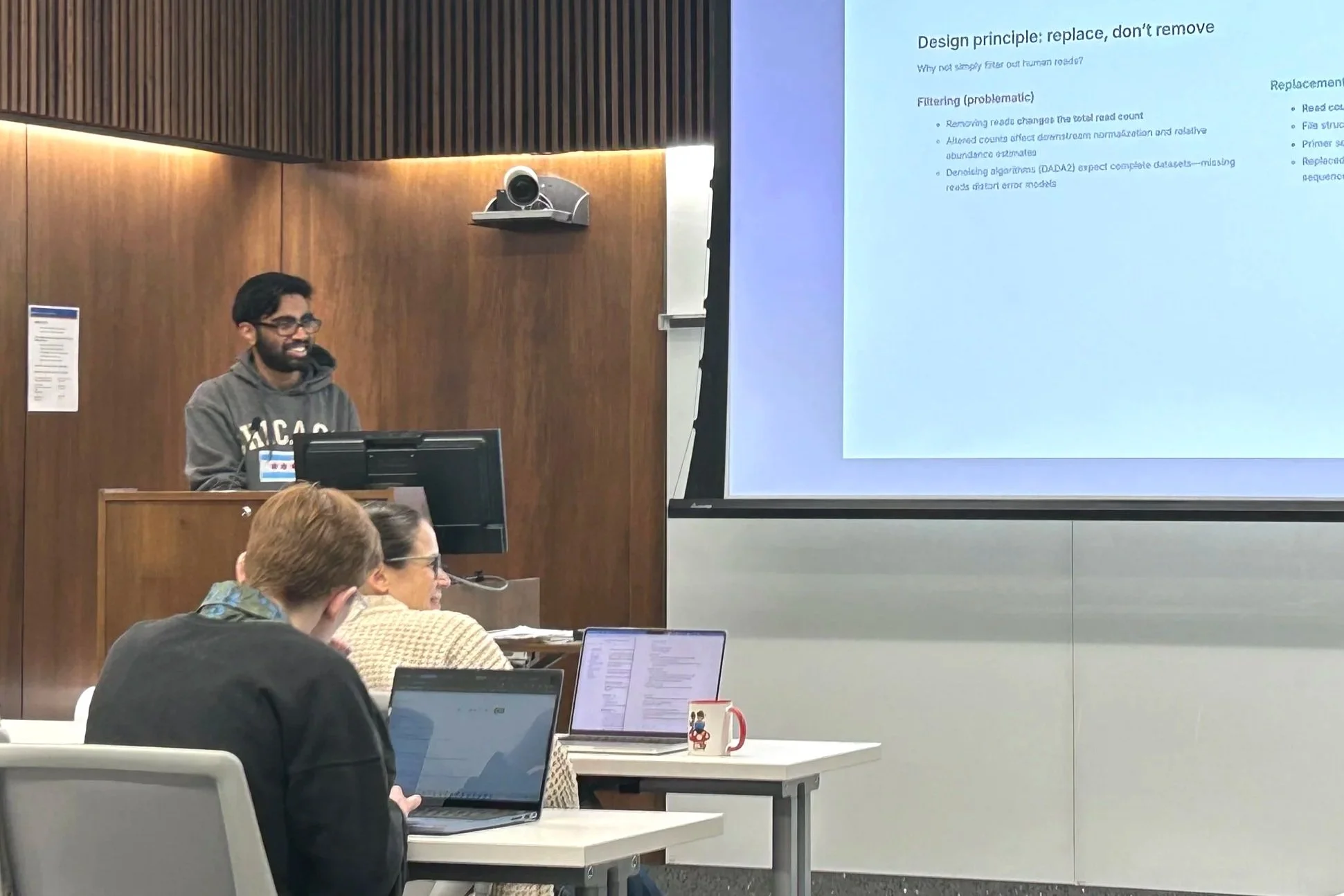
Ashish shares updates on his progress identifying and distinguishing objects using tools from the new David Lab Biostatistics Handbook. He listed Claude as a co-presenter and quipped that the A.I. program infused the presentation with what it called his “self-deprecating humor.”
One of the more notable accomplishments of the David Lab is the development of FoodSeq, a novel DNA-metabarcoding process that allows researchers to identify the plants and animals comprising a person’s diet. Over the years, lab members—ranging from grad students and postdocs to staff scientists and technicians—have built and refined the code and protocols that make FoodSeq a powerful tool.
In the past, these resources were somewhat siloed among individual lab members and passed down by word of mouth. The system worked well when FoodSeq was in its infancy, but as the David Lab grew and the technology was validated, a more uniform system was needed. That’s where Ashish Subramanian comes in.
“This has been a work in progress since I joined the lab—and even before that,” he says of the process of collating myriad code and protocols related to FoodSeq. “We’re systemizing everything and standardizing it.”
Over the past 18 months, Ashish has built a comprehensive repository from the ground up. The internal version came online a year ago, but just last month, the public-facing website, known as the David Lab Biostatistics Handbook, went live on GitHub. “It’s essentially the instructions of how to do the bioinformatics and dry lab side of FoodSeq. So, once you have the raw sequencing data, how do you analyze it?” he explains. “That was pretty big because we’ve never had anything like that in the lab’s existence.”
He credits postdoc Dorothy Superdock and graduate student Caroline Rivera for having the institutional knowledge to help him build the handbook. Current graduate students Ben Neubert and Jun Zeng, as well as former ones, Ammara Aqeel and Teresa McDonald, were also instrumental in piecing together files that were spread across multiple data repositories.
Beyond amalgamation, Ashish has also updated the code to include the latest advances in FoodSeq. These modernizations include the ability to anonymize human reads and run multiplex sequencing, combining 12S and trnL into a single read.
The David Lab has already shared the new GitHub resource with five working groups. The hope is that more researchers will organically find the site, even if they have no prior experience collaborating with the lab. Ashish’s work also makes this scenario more likely. In addition to standardizing FoodSeq’s bioinformatics resources, he has made the process more user-friendly by creating step-by-step directions—essentially an online tutorial for new users—so researchers with even a basic understanding of R and shell programming will find the handbook straightforward. “Anyone who’s used the wet lab can now follow these instructions, which start at the very beginning,” he adds.
Originally from Chicago, Ashish joined the David Lab immediately after completing a dual degree in Health and Medical Geography of Human-Environment Interactions and Global Health at Duke University. As an undergraduate, his statistical training skewed toward network modeling of infectious diseases and associated risk factors, with less emphasis on bioinformatics and biostatistics. For Ashish, becoming the David Lab’s resident biostatistician wasn’t a trial by fire but rather an opportunity to expand his skill set and learn more about nutrition and chronic diseases.
"This lab is the perfect way for me to bridge that gap and really round out the different skills I have. And the work really hits my interests; we look at the geography of food and nutrition and global health. There are a lot of environmental factors and epidemiological perspectives at play,” he says. “So, I'm getting to explore these new skills but still address those interests I've always had, just in a very different way.”
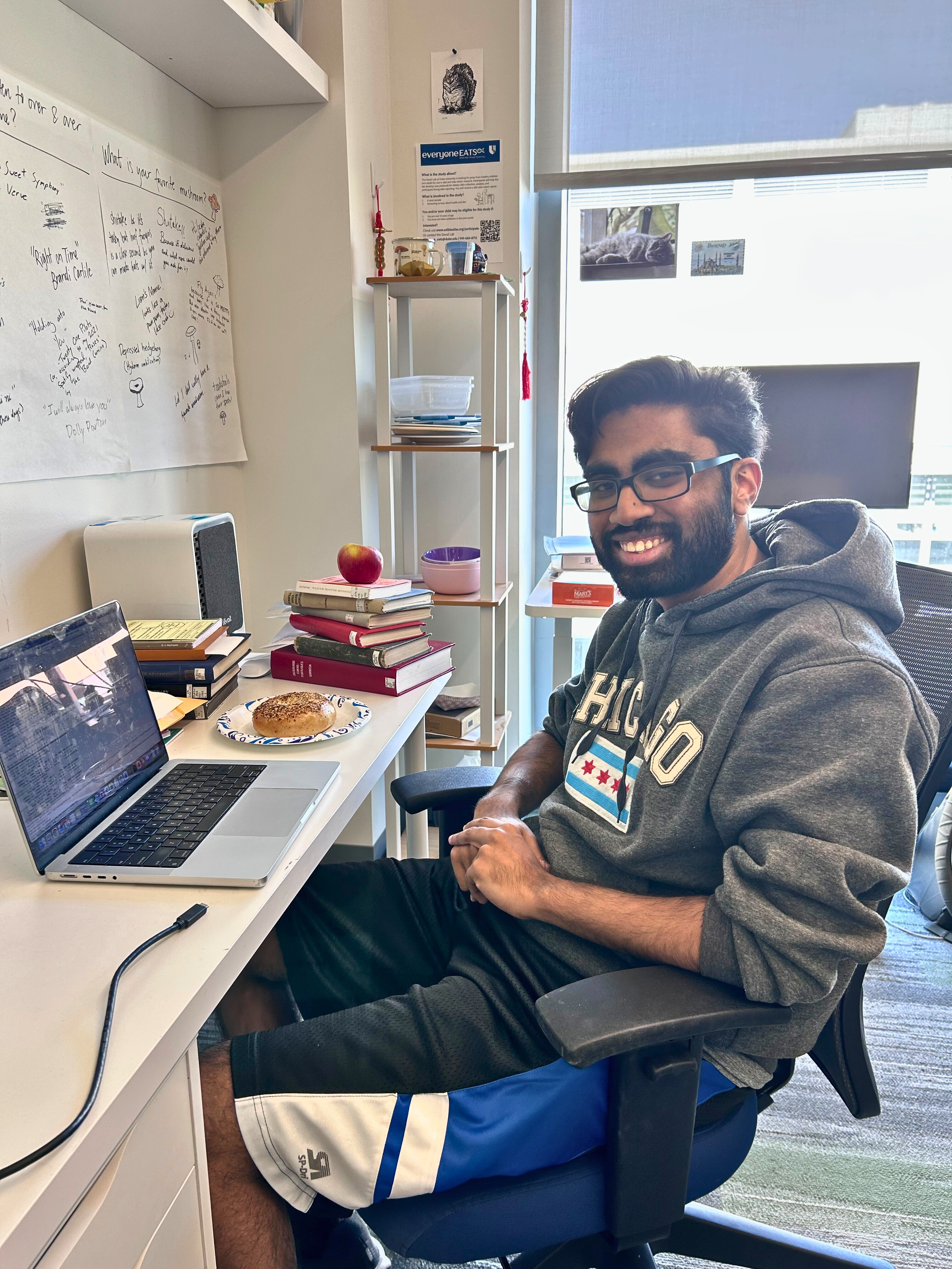
Around the lab, Ashish is known as the team member who always has a thick pile of books on his desk.
While interdisciplinary research and cross-collaboration are bedrock values of the David Lab, Ashish’s role is especially eclectic. In addition to building the internal and public-facing versions of the David Lab Biostatistics Handbook, he’s also actively involved in multiple projects at any given time, providing dry lab support to nearly every team member.
“One of the really fun things about my position is that I basically work with everybody; I'm not on any one specific project at a time,” he explains. “I'm trying to link the past, the present, and the future.”
At present, Ashish feels a new sense of urgency in his work. He’s applying for MD/PhD programs and could matriculate as early as this fall. While the David Lab Biostatistics Handbook is live, he stresses that it is a living document that still requires more input and updates. He’s continuing to collaborate with lab members, creating protocols related to their work and modernizing existing code across different applications.
“There's still so many things to add, and the importance of it is all the more heightened by the fact I may be leaving the lab,” he says. “The institutional memory that I've gained from being here needs to be on that website.”
As someone with a wide range of interests and an eagerness to learn new skills, Ashish is in no rush to commit to a specialty. He sees his MD/PhD education focusing on epidemiology, public health, or a related field but hopes that, in the early years of the program, he’ll be exposed to an even greater variety of disciplines. “I'm telling myself that if I really need to get hyper-focused on something, I can do it over the eight years of an MD/PhD. Now is really the time to cover all my bases and make sure I really get a solid foundation so I can make an informed decision when I start narrowing things down,” he explains.
In reflecting on his time as the David Lab’s resident biostatistician, Ashish is grateful for how the experience has broadened his skill set, improved his understanding of nutrition and diet, and challenged him to tackle problems in new ways. He’ll continue to grow these competencies until it’s time to begin the next chapter.
“The GitHub website will occupy a big part of my time until I leave. I’m documenting everything in a way that future lab members can use,” he says. “As far as other projects, it's a matter of what comes to my desk. I'm happy to help people with whatever they need.”
For someone whose work involves zeroing in on the most minute variables, Ashish has no trouble seeing the big picture when it comes to his own scientific journey. Seemingly disparate data points, from building a website called GeoGenius in high school to working at the Nunn Lab as an undergraduate to systemizing far-flung code at the David Lab, connect to each other, creating something larger and richer than the individual points would suggest.
“I don't exactly know what the future will look like, but I hope it bridges what I did as an undergrad with what I'm doing currently with my interests in health, medical geography, and environmental science,” he reflects. “It’s really a joy to work with people from all kinds of backgrounds and perspectives.”