
More Than a ‘Bacteria Guy’: Jun Zeng’s Journey to Translational Research
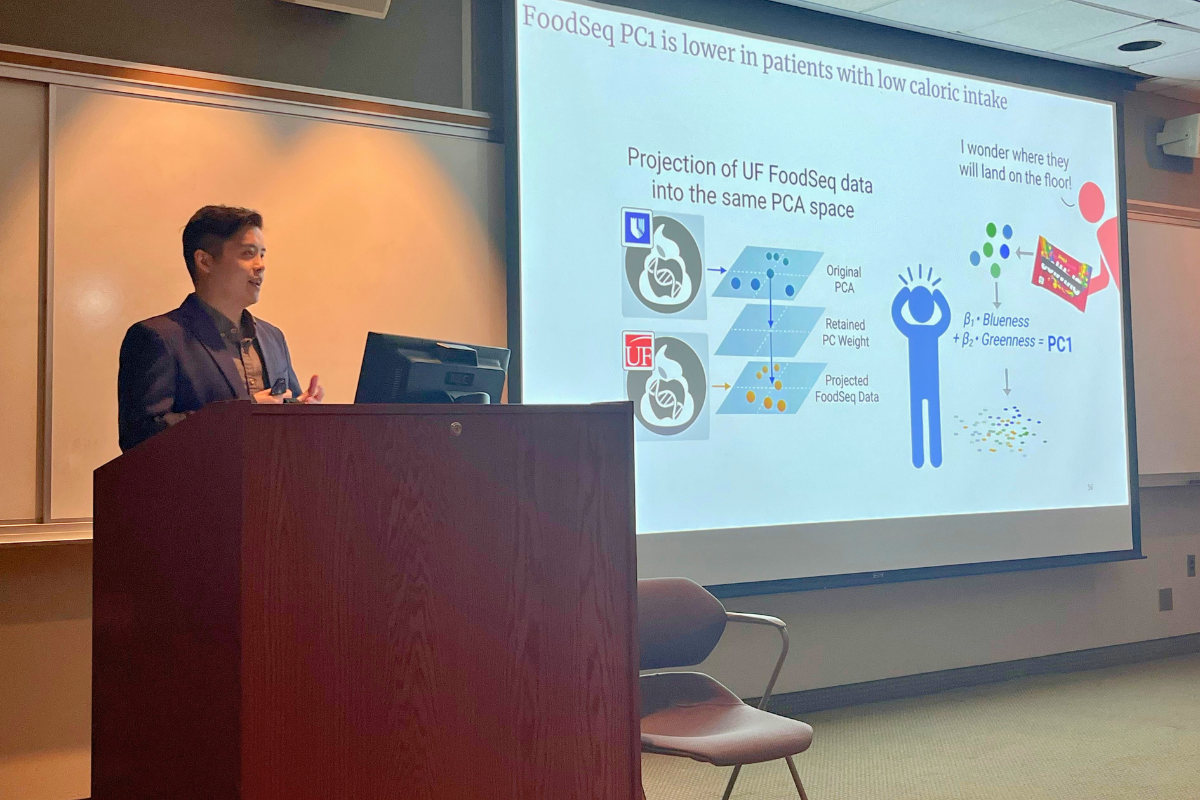
In March 2026, Jun successfully defended his dissertation, which began with a focus on the microbiome and expanded to include nutrition and meta-genomics. Now he’s pursuing postdoctoral opportunities with clinical applications.
When Jun Zeng joined the David Lab in 2020, he envisioned his graduate work centering around the gut microbiome, which, at the time, was the lab’s primary focus. And just as the lab has evolved into Edible Atlas and the research has morphed from modulating the microbiome via food to identifying consumed foods through dietary-based genomics, so too did Jun’s research grow.
“I started grad school with a mindset that I would just look at the microbiome, but then we pivoted to this amazing project with diet as a main focus,” he says. In March, Jun successfully defended his dissertation, “Illuminating the Event Horizon in Clinical Diet-Microbiome Research Through Retrospective Amplicon Sequencing of Diet-Derived Fecal DNA,” capping a years-long project that took him in unexpected directions and have been crucial in shaping his goals for the future.
Just as the lab’s progression from microbiome to meta-genomics was organic, so too was Jun’s research shift. He connected with Dr. Anthony Sung, an adjunct associate professor of medicine in Duke’s School of Medicine, who was supervising a cohort of bone marrow transplant recipients at Duke. Researchers already knew that diet affected the microbiome; they also knew that the microbiome impacted health outcomes and recovery times in these patients, many of whom struggled to eat or drink anything as a result of chemotherapy. Although diet and recovery times were linked by the microbiome, researchers hadn’t yet studied the direct relationship between the foods patients consumed and how they fared after the transplant.
This was something Jun could explore on the backend, conducting secondary analyses of the Duke cohort and other independent studies at the University of Florida and Memorial Sloan Kettering (MSK) Cancer Center.
“There was an interesting angle with the microbiome, but at the same time, we saw that because some patients suffered from chemotherapy-induced mucositis, they also had to undergo total parenteral nutrition (TPN), where instead of eating foods, nutrients were injected directly into the bloodstream,” Jun explains. “So, initially, we thought, ‘What if we look at how the microbiome may be different between patients who have TPN versus those who don't.’”
In addition to nutrients, TPN also delivers calories, another crucial component to successful recovery. “Because these patients have received a bone marrow transplant, their bodies need to make a lot of new blood cells, so their calorie intake requirement is 50 percent higher and could be as much as 3,500 kilo-calories per day,” Jun says. Age, weight, activity level, pre-existing conditions, and other factors can influence calorie recommendations for adults, but the USDA generally recommends a daily intake of 1,600 to 2,400 kilo-calories for healthy females and 2,000 to 3,000 for males.
But Jun’s early focus on the microbiome of patients on TPN changed when he realized that a very basic but also paramount question remained unanswered: Were patients eating enough? The short answer was no. Bone marrow transplant recipients in the University of Florida cohort who were not on TPN averaged only 700 kilo-calories per day while the MSK cohort clocked in at roughly 1,000 kilo-calories. (The Duke cohort did not track calorie counts.) This is where FoodSeq—and the second part of Jun’s research—came into play.
“Unless you’re running a study like the ones at Florida or MSK, people don't usually just track what patients eat. The reason why we don't have dietary data is because it's just not routine in the hospital to keep an eye on what patients are eating every day,” he says.
FoodSeq offers a viable method to collect these missing data. The technology identifies residual plant and animal DNA in stool samples, and while it doesn’t measure calories per se, it can plot the relative abundance of plant and animal species. Patients who are barely eating will have fewer common plant and animal taxa in their stool compared to those who are consuming more. And because Jun’s project was longitudinal with samples from the same patients over time, he could detect changes in their dietary patterns.
Jun’s work not only helped validate FoodSeq’s accuracy, it also offered a potential solution to a pain point he hadn’t known existed. “It’s shocking to see just how difficult it is to get dietary data from these patients. I always thought of hospitals as very controlled environments; patients literally stay there and eat from the same menu,” he says. “But dietary information isn’t actually being tracked unless you design a study to acquire that data.”
One of the many benefits of FoodSeq is that it can be used retroactively to analyze fecal samples from various sources. For Jun’s purposes, this meant he could sequence stool from across all three cohorts even years after the studies were completed. Plus, in a single analysis he could examine both the composition of the microbiome and the diet of the patients.
After all, the microbiome remains an integral part of his research and future pursuits. “My next step will be continuing on this path of academic research and bringing back that passion for the microbiome,” he says. “I'm still a bacteria guy; I'm still a microbiome guy.”
Moving forward, Jun is interested in pursuing postdoc opportunities. For now he’s taking a brief sabbatical, visiting with friends and family before beginning the next phase of his research and career. His graduate studies at the David Lab and working with Dr. Sung not only broadened his academic interests to include dietary genomics, the experiences also made him appreciate the connection between wet lab work and clinical applications.
“Because of this project in grad school that focused on clinical cohorts, I realized how powerful translational science can be. It can generate data that's not necessarily focused on biological mechanisms but more focused on patient care,” he says. “That's what I want to do: not just microbiome research but translational microbiome research.”